
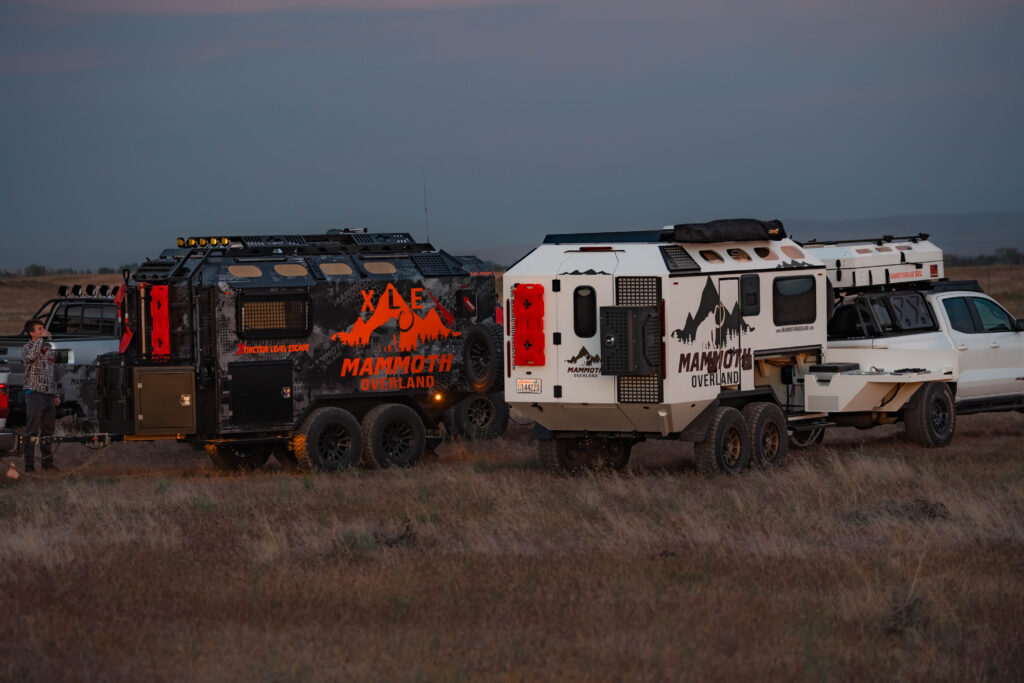
Mammoth Overland is a Woodinville, Washington-based manufacturer of off-road camper trailers built using aerospace-grade aluminum construction and manufacturing techniques borrowed directly from its parent company, Vashon Aircraft. Founded by Scott Taylor, a former Boeing production manager, Mammoth Overland builds four trailer models — HV, WLY, TL, and ELE — ranging in price from roughly $32,500 to $124,000, each constructed in the same Woodinville facility where Vashon builds its Ranger ultralight aircraft.
The Short Answer
If you’re trying to understand what makes Mammoth Overland different from other off-road trailer manufacturers in a single sentence: it’s an aircraft company that also happens to build trailers, and it builds them the way it builds airplanes.
That distinction matters more than marketing copy might suggest. Most off-road trailer manufacturers come from an RV or fabrication background. Mammoth Overland’s engineering team comes from aerospace — and that shows up in the monocoque aluminum construction, the manufacturing tolerances, and the underlying philosophy that a trailer should be engineered, not just built.
The Origin Story
Mammoth Overland was founded by Scott Taylor, who spent years as a production manager on Boeing military and commercial aircraft programs before turning his attention to recreational vehicles. Taylor is also the President and COO of Vashon Aircraft, the company’s parent, which manufactures the Vashon Ranger — a popular ultralight aircraft built in the same Woodinville, Washington facility as Mammoth’s trailers.
That shared facility isn’t a coincidence or a marketing detail. Mammoth Overland’s trailers are built using the same aluminum materials, production equipment, and quality control processes used on the Ranger aircraft line. The company’s own description of its construction methodology centers on monocoque design: the inner and outer aluminum skins of the trailer work together as a single structural unit, the same engineering principle used in aircraft fuselages, rather than relying on a separate frame with body panels attached afterward.
What Makes the Construction Different
Most off-road trailers on the market are built using a steel or aluminum frame with a separate shell bolted or riveted on top. Mammoth Overland’s trailers use monocoque construction instead — meaning the body itself is the structure. There’s no wood in the build process, which eliminates the rot and water-damage issues that plague many traditional trailers over time, and the aluminum skins are riveted directly to the chassis the way an aircraft fuselage is assembled.
This approach delivers a meaningful weight advantage. The company’s entry-level HV model has a dry weight of just 1,650 pounds despite its rugged off-road capability — light enough to be towed by mid-size trucks and SUVs rather than requiring a heavy-duty pickup. That’s a direct result of aerospace construction techniques prioritizing strength-to-weight ratio over brute material thickness.
The Mammoth Lineup
Mammoth Overland currently builds four trailer models, each sharing the same core cabin and frame construction but differentiated by intended use case:
| Model | Starting Price | Primary Use Case |
|---|---|---|
| HV | $32,500 | Standard all-around off-road teardrop trailer |
| WLY (“Wooly”) | $59,500 | Extreme cold-weather and four-season camping |
| TL (“Tall Boy”) | $72,000 | Full-height family trailer with bathroom and bunks |
| ELE (“Extinction Level Event”) | $67,000+ | Extreme self-sufficiency and security-focused trailer |
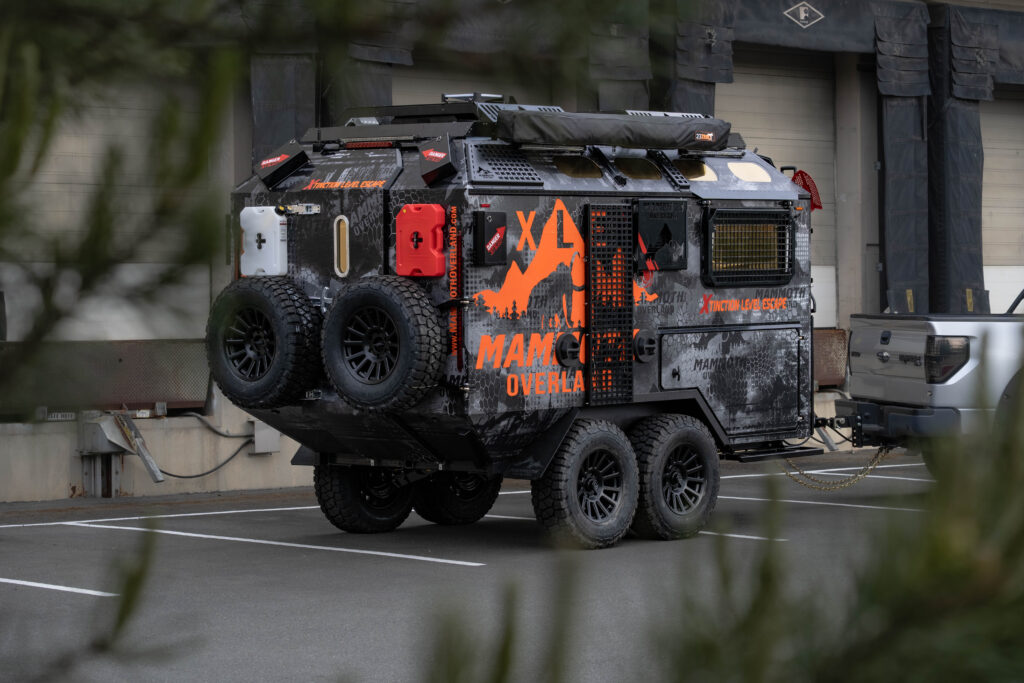
A fifth model, the XLE (“Xtinction-Level Escape”), launched in 2026 as the brand’s most capable trailer to date, combining the TL’s full-height family-friendly platform with the ELE’s hardcore survivalist feature set. It’s priced at $123,994.
Why the Brand Has Generated So Much Media Coverage
Mammoth Overland has earned an unusual amount of press attention for a low-volume, direct-to-consumer trailer manufacturer — coverage from outlets including GearJunkie, Expedition Portal, Autoweek, RV Business, and Overland Journal, among others. Much of that attention traces back to the ELE model, which built in features like a pressurized cabin with medical-grade air filtration, an integrated bear-spray defense system, weapons storage, and skid plating. The trailer was explicitly designed, in Taylor’s own words, to handle “whatever campers might encounter, from bears to wildfires to social unrest.”
That willingness to build genuinely extreme, headline-worthy features — rather than incremental updates to a conventional teardrop trailer — has made Mammoth Overland one of the more talked-about names in the overlanding space relative to its production volume.
Direct-to-Consumer Sales Model
Mammoth Overland sells trailers directly from its Woodinville facility rather than through a dealer network, which the company says allows it to avoid dealership markups and pass the savings on to buyers. Customers place a refundable deposit to secure a build slot, and most trailers are built to order with a range of optional upgrades — solar packages, lift kits, cabin heating and cooling, and MOLLE-panel storage accessories, among others.
The company also offers a $1,000 discount off the base trailer price for active duty military, veterans, and first responders, and encourages customers to pick up their trailers in person in Washington, often turning delivery day into the start of a cross-country adventure.
Frequently Asked Questions
Who owns Mammoth Overland?
Mammoth Overland is a subsidiary of Vashon Aircraft, a U.S. aircraft manufacturer. Both companies are led by Scott Taylor, who serves as President of Mammoth Overland and President/COO of Vashon Aircraft.
Where are Mammoth Overland trailers built?
All Mammoth Overland trailers are built in the company’s production facility in Woodinville, Washington — the same facility where Vashon Aircraft builds its Ranger aircraft.
What makes Mammoth Overland different from other off-road trailer brands?
Its aerospace-grade monocoque aluminum construction, shared manufacturing process with an aircraft company, and a product lineup that includes some of the most extreme feature sets in the off-road trailer market, particularly on the ELE and XLE models.
How many trailer models does Mammoth Overland make?
Five, as of 2026: HV, WLY, TL, ELE, and XLE.
Ready to explore the Mammoth Overland lineup? Browse all models or reserve your build slot today.