
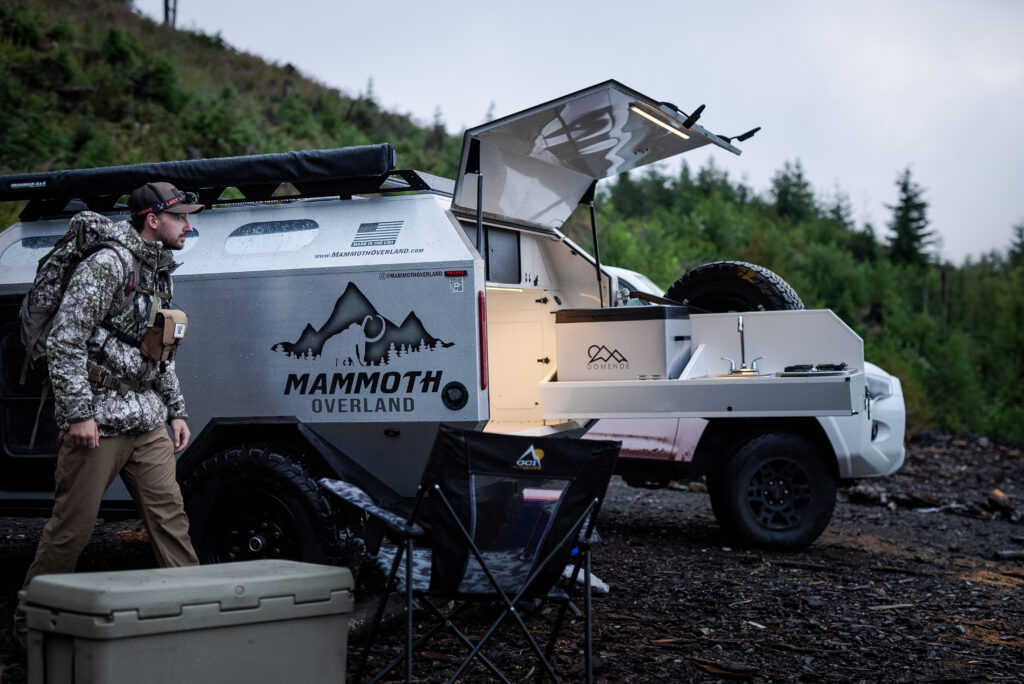
The Mammoth Overland HV is the brand’s standard off-road teardrop trailer, starting at $32,500. Built from aerospace-grade monocoque aluminum with no wood in its construction, the HV weighs just 1,650 pounds dry, making it towable by mid-size trucks and SUVs while delivering the off-road durability and engineering pedigree shared across the entire Mammoth Overland lineup.
The Short Answer
The HV is Mammoth Overland’s entry point — the trailer that established the brand’s monocoque aluminum construction, off-road capability, and direct-to-consumer pricing model before the company expanded into the cold-weather WLY, family-focused TL, and extreme-feature ELE and XLE models. If you’re trying to understand the core Mammoth Overland platform before evaluating the rest of the lineup, the HV is where to start.
Full Specifications
| Spec | Detail |
|---|---|
| Starting price | $32,500 |
| Dry weight | 1,650 lbs |
| Max gross weight | 3,500 lbs |
| Tongue weight | 280 lbs |
| Length | 13’11” |
| Width | 7’3″ |
| Exterior height | 6’2″ |
| Interior cabin height | 4’2″ |
| Construction | Monocoque aluminum, no wood |
| Standard tires | 30″ on 16″ steel wheels |
| Insulation | R5 value panels |
| Standard battery | 100Ah AGM |
| Solar | 15-amp controller, SAE connections, solar-ready |
Construction and Durability
The HV uses the same monocoque aluminum construction found across the entire Mammoth Overland lineup — the inner and outer aluminum skins work together as a single structural unit, the way an aircraft fuselage is built, rather than relying on a separate frame with a shell bolted on top. That approach eliminates wood from the build entirely, which means no rot, no water damage to structural components, and a build the company designs to last for generations of ownership.
The trailer also features a pivoting hitch design that allows the trailer to articulate independently of the tow vehicle off-road — a detail multiple reviewers have called out as a meaningful safety and capability advantage on technical trails, since it prevents the trailer’s movement from affecting how the tow vehicle behaves over obstacles.
What’s Standard vs. What’s Optional
The HV ships with a usable baseline of features and a long list of available upgrades, which keeps the entry price competitive while letting buyers build toward their specific use case.
Standard on every HV:
- Roof rack and manual-deploy awning
- Pop-up privacy shelter for showering
- Stabilizing jacks
- Fold-down bunk (sized for kids or dogs)
- Solar-ready 15-amp controller
- 100Ah AGM battery
- On-demand hot water
- Six interior storage nets
Popular optional upgrades:
- 2″ suspension lift with 33″ tires on 17″ wheels (adds roughly 3″ of height)
- Cabin heater and cooling
- Articulating 3-axis off-road hitch for improved trail performance
- MOLLE panel storage (2 or 4 panels per side)
- Roof-mounted observation deck
- Extended bunk (8 additional inches)
- RotopaX fuel and water mounts
Interior Layout and Livability
The HV’s interior cabin height of 4’2″ reflects its teardrop-style design — it’s not a stand-up trailer, which is the primary tradeoff buyers make for its lighter weight and lower price compared to the full-height TL. Inside, the trailer is built around a kitchen that folds out from the rear hatch rather than living inside the cabin, a layout shared across the HV, WLY, and ELE platforms. The kitchen includes a two-burner propane stove, a sink connected to an instant water heater, and a 45-quart fridge, with a pass-through storage area connecting the kitchen to the cabin interior.
Exterior lighting is handled by rock lights mounted on each side of the trailer, controlled from inside the cabin, along with a dimmable LED strip integrated into the awning frame.
How the HV Compares to the Rest of the Lineup
The HV shares its core cabin and frame with the WLY and ELE models — the difference between those trailers comes down to insulation, accessories, and feature sets layered on top of the same base platform. The WLY adds R25 floor insulation and R10 wall insulation for extreme cold-weather use. The ELE adds a pressurized cabin, medical-grade air filtration, bear-spray defense, and weapons storage for self-sufficiency-focused buyers. The TL, by contrast, uses a taller, stand-up cabin design rather than the HV’s teardrop shape, trading some weight efficiency for livability.
For buyers who want Mammoth Overland’s core engineering and off-road capability without the cold-weather or survivalist feature additions, the HV remains the most accessible and lightest option in the lineup.
Frequently Asked Questions
How much does the Mammoth HV cost?
The HV starts at $32,500, including a 100Ah AGM battery and on-demand hot water. Optional upgrades — lift kits, cabin climate control, storage accessories — add to that base price depending on configuration.
How much does the Mammoth HV weigh?
The HV has a dry weight of 1,650 pounds and a max gross weight of 3,500 pounds, making it towable by most mid-size trucks and SUVs.
Can the Mammoth HV be used in cold weather?
The HV comes with standard R5 insulation, which is adequate for moderate conditions but not designed for extreme cold. Buyers planning extensive winter use should consider the WLY, which is purpose-built for sub-zero temperatures with significantly higher insulation values.
Is the Mammoth HV good for off-roading?
Yes — the HV’s lightweight monocoque construction, available off-road hitch articulation, rock sliders, and high ground clearance options are specifically engineered for technical trail use, and the trailer has been reviewed favorably by multiple overlanding outlets for its off-road manners.
Ready to build your own HV? Configure your trailer or place your reservation directly with Mammoth Overland.