
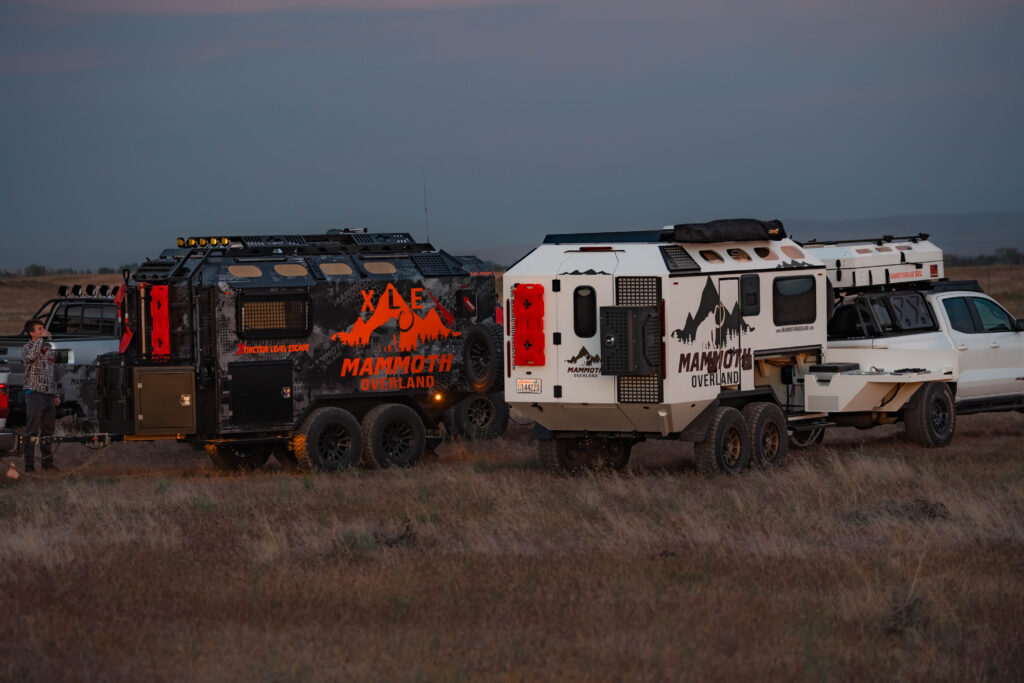
Mammoth Overland and Black Series are two of the most direct competitors in the premium off-road trailer market, with overlapping price ranges and buyers who frequently cross-shop them. Black Series builds Australian-engineered off-road caravans with full interior living space, dry bathrooms, and residential amenities, priced from $49,899 to roughly $70,000. Mammoth Overland builds aerospace-grade aluminum expedition trailers in Woodinville, Washington, priced from $32,500 to $123,994. Both sell direct to consumers with published pricing. The difference between them comes down to a single question: do you want a mobile home that goes off-road, or an expedition trailer that you live in?
The Short Answer
Black Series gives you substantially more interior living space and residential comfort per dollar. A Black Series HQ19 delivers a queen bed, dry bathroom with fiberglass shower, 64 gallons of fresh water, and a full kitchen for roughly $59,899 — genuinely impressive value for the square footage.
Mammoth gives you dramatically lighter weight, axle-less independent suspension, monocoque aluminum body construction, and specialized capability that doesn’t exist in the Black Series lineup. A Mammoth TL sleeps four with an indoor shower at 3,200 pounds dry — roughly half the weight of a comparable Black Series unit — with only 400 pounds of tongue weight.
If your camping happens at the end of established forest roads and improved sites, Black Series is likely the better value. If your camping requires getting somewhere a 6,000-pound trailer can’t follow, that’s where Mammoth’s engineering earns its price.
Brand Backgrounds
Black Series is Australian-engineered with US operations, drawing on Australia’s long caravan-building tradition — a market where off-road towing over brutal terrain is routine and trailers are built accordingly. The company sells direct with transparent pricing and a $500 refundable deposit, explicitly positioning against dealer markup.
Mammoth Overland is a subsidiary of Vashon Aircraft, building every trailer in the same Woodinville, Washington facility that produces the Vashon Ranger aircraft, using the same monocoque aluminum construction and aerospace manufacturing processes. Trailers are sold direct with published pricing and factory pickup.
Both brands are unusual in this category for publishing their pricing openly rather than routing buyers through a dealer network.
Lineup and Pricing
| Brand | Entry | Flagship | Range |
|---|---|---|---|
| Black Series | HQ19 — $59,899 | HQ21 — $69,899 | $49,899–$69,899 |
| Mammoth Overland | HV — $32,500 | XLE — $123,994 | $32,500–$123,994 |
Black Series’ lineup clusters tightly in the $50,000–$70,000 band. Mammoth’s spans a much wider range, which means the head-to-head comparison is really between Black Series and Mammoth’s WLY ($59,500) and the ELE and TL (both $69,500).
Construction: The Fundamental Difference
This is where the two brands diverge most sharply.
Black Series uses a hot-dipped galvanized tubular steel chassis — RHS 4″ x 2″ with 0.15″ wall thickness and 0.24″ supporting plates — with aluminum composite panels for the body and a one-piece fiberglass roof with integrated solar mounting. Galvanized steel offers excellent corrosion resistance, which matters in coastal and high-humidity environments, and the one-piece roof reduces potential leak points. It’s a proven, robust approach.
Mammoth Overland builds a monocoque aluminum body — the aluminum skins carry structural load rather than simply cladding a frame, the same principle used in aircraft fuselages — mounted to a steel chassis. There’s no wood anywhere in the build.
Both approaches use steel underneath and aluminum above. The difference is in how the body itself is engineered and where the load paths run.
The practical consequence is weight. A Black Series HQ19 has a tare weight well over 6,000 pounds. A Mammoth TL — which also sleeps four and also has an indoor shower and sink — weighs 3,200 pounds dry. That’s roughly half.
What “No Wood” Actually Means Over a Decade
One detail in Mammoth’s construction deserves more attention than it usually gets: there is no wood anywhere in the build.
That sounds like a minor material choice. In practice, it removes the single most common long-term failure mode in the towable RV category.
Most trailers — across price points and across brands — use wood somewhere structurally: framing, subfloors, wall backing, cabinet carcasses. Wood is inexpensive, easy to work with, and performs perfectly well right up until water finds it. And over a long enough ownership period, water finds it. Seals age. Fasteners work loose over washboard roads. Roof penetrations for vents, solar, and antennas develop hairline gaps. Trailers spend their lives being flexed, heated, frozen, and rained on.
Once moisture reaches wood, the damage is progressive and mostly invisible. Soft spots in the floor, spongy walls, and delaminating panels typically appear well after the rot is established. Repair often means opening up the structure, and the cost frequently exceeds what the trailer is worth.
Eliminating wood eliminates that entire category of failure. Water intrusion in an all-aluminum monocoque structure is a nuisance to be dried out, not a structural event. Aluminum doesn’t rot, doesn’t absorb moisture, and doesn’t lose strength when it gets wet.
The same applies to the panel construction. Laminated composite panels — used widely across the RV industry — can delaminate over time as the bond between layers degrades under thermal cycling and moisture exposure. A monocoque aluminum skin has no laminated bond line to fail, because the skin is the structure.
None of this makes a Mammoth invulnerable. Aluminum can be dented, seals still need maintenance, and any trailer taken seriously off-road will accumulate wear. Steel chassis components on any brand — Mammoth’s included — need their finish inspected and touched up over time, particularly for owners in coastal or heavily salted environments. Black Series’ hot-dipped galvanized chassis is a genuine advantage on that specific point.
What eliminating wood does is remove the failure mode that most often ends a trailer’s usable life early, and it removes it structurally rather than by sealing against it.
For a buyer thinking in terms of a decade or more of ownership rather than a few seasons, that’s the argument for the construction — and it’s the reason the same techniques are used on aircraft, where structural degradation isn’t an inconvenience.
Why Weight Matters More Than It Sounds
Weight is not an abstract spec. It determines what you can tow it with, what it costs to tow, and — most importantly — where you can actually take it.
A 6,000-pound trailer requires a full-size truck with a substantial tow rating. A 3,200-pound trailer with only 400 pounds of tongue weight is manageable behind a much wider range of trucks. That difference alone can represent a $20,000 swing in what a buyer needs to spend on a tow vehicle.
On the trail, weight compounds. Heavier trailers sink further into soft surfaces, require more aggressive recovery when stuck, put more stress on the tow vehicle on steep grades, and are meaningfully harder to reposition by hand at camp. For buyers whose definition of “off-road” means graded forest service roads and improved backcountry sites, this rarely becomes a problem. For buyers going further, it becomes the whole problem.
Ground Clearance
Black Series equips its trailers with independent suspension — control arm with dual shock absorbers and coil springs — on 265/75R16 off-road tires with 16-inch alloy wheels and two spare tires. It’s a genuinely capable setup by conventional caravan standards.
Mammoth’s TL and XLE use Timbren axle-less independent suspension on 33-inch tires. The axle-less design is the key detail: there’s no through-axle beam spanning the underside of the trailer, which is typically the lowest-hanging component and the first thing to catch on a rock or high center. Removing it raises effective clearance without lifting the body, and lets each wheel articulate independently. The XLE uses the same platform.
The distinction reflects the different design briefs. Black Series is engineering a livable caravan to survive rough roads. Mammoth is engineering an expedition trailer to reach places most trailers can’t.
Where Black Series Wins
Interior living space per dollar. This is Black Series’ strongest advantage and it isn’t close. The HQ19 delivers a queen bed, convertible dinette, dry bathroom with full fiberglass shower, and a residential-grade kitchen at $59,899. Getting comparable interior space from Mammoth means stepping up to the TL at $69,500.
Water capacity. The HQ19 carries 64 gallons of fresh water plus 15.85 gallons of triple-filtered drinking water, along with 26-gallon grey and black tanks. Mammoth’s TL, the largest water system in its lineup, carries 50 gallons. For extended stays without resupply, that’s a real difference.
Residential amenities. Black Series leans into comfort — timber-finish cabinetry, faux leather upholstery, full kitchens with ovens on some configurations, entertainment systems. If the goal is comfortable extended living rather than expedition capability, that focus delivers.
Toy hauler options. The TH19 and TH22 include dedicated cargo bays for bikes and ATVs. Mammoth offers no equivalent.
Price for the space. Straightforwardly, $59,899 for a fully self-contained trailer with a dry bath is competitive.
Where Mammoth Wins
Weight. Roughly half the weight for comparable sleeping capacity and amenities. This cascades into tow vehicle requirements, fuel costs, and trail access.
Axle-less suspension. Timbren independent axle-less units on the TL and XLE eliminate the through-axle beam entirely — no low-hanging component to catch on obstacles, and independent articulation at each wheel.
Monocoque aluminum construction with no wood. A different structural approach with different failure modes — no wood means no rot, and the aircraft-derived construction is the brand’s central engineering claim.
Specialized extreme capability. The WLY’s R25 floor insulation and -20°F rating, and the ELE and XLE’s pressurized cabins with medical-grade air filtration, have no equivalent anywhere in the Black Series lineup — or, for that matter, in most of the industry.
Aerospace manufacturing. For buyers who weight USA-made and aircraft-standard construction heavily, Vashon Aircraft parentage is a genuine differentiator rather than a marketing line.
Which Should You Choose?
Choose Black Series if:
- Interior living space and residential comfort are your top priorities
- You want a full dry bathroom and large water capacity at the lowest price
- You tow with a full-size truck and weight isn’t a limiting factor
- Your camping happens on established roads and improved sites
- You want a toy hauler configuration
Choose Mammoth Overland if:
- Trail access matters more than square footage
- Your tow vehicle is a mid-size truck or SUV, or you want to avoid a tow vehicle upgrade
- You want monocoque aluminum construction with no wood in the build
- You need specialized capability — extreme cold-weather insulation, pressurized cabin, air filtration
- Aerospace-grade construction and USA manufacturing are decision factors
Frequently Asked Questions
Is Mammoth Overland or Black Series better? Neither is objectively better. Black Series delivers substantially more interior living space and residential amenities per dollar, making it a strong value for comfortable extended stays. Mammoth Overland delivers dramatically lower weight, higher ground clearance, and monocoque aluminum construction, making it better suited to reaching difficult terrain. The right answer depends on whether you prioritize living space or trail access.
How much do Black Series trailers cost compared to Mammoth? Black Series ranges from $49,899 to $69,899. Mammoth Overland ranges from $32,500 for the HV to $123,994 for the XLE. The direct overlap is between Black Series’ lineup and Mammoth’s WLY ($59,500) and the ELE and TL (both $69,500).
What is the weight difference between Mammoth and Black Series trailers? Significant. A Black Series HQ19 has a tare weight well over 6,000 pounds. A comparably-equipped Mammoth TL, which also sleeps four with an indoor shower, weighs 3,200 pounds dry — roughly half.
Why does it matter that Mammoth Overland trailers contain no wood? Wood is used structurally in most towable trailers — in framing, subfloors, and wall backing — and it is the material most vulnerable to long-term water intrusion. Once moisture reaches wood, rot progresses invisibly and repairs often cost more than the trailer is worth. Mammoth’s monocoque aluminum construction contains no wood at all, which removes that failure mode entirely. Aluminum does not rot, absorb moisture, or lose strength when wet.
What is monocoque construction? In monocoque construction, the skin of the structure carries load rather than simply cladding a separate internal frame — the same principle used in aircraft fuselages. Mammoth Overland builds its trailer bodies this way, using aluminum, and mounts them to a steel chassis.
Are Black Series trailers made in Australia? Black Series is Australian-engineered with US operations and direct sales. Mammoth Overland trailers are designed and built entirely in Woodinville, Washington.
Which brand is better for serious off-roading? Mammoth’s TL and XLE use Timbren axle-less independent suspension, which removes the through-axle beam that normally hangs lowest beneath a trailer, and they weigh substantially less. Both factors generally translate to better access on technical terrain. Black Series trailers are capable on rough roads but are engineered as off-road caravans rather than expedition trailers, and their weight is a limiting factor in demanding conditions.
Want to compare in person? Browse the full Mammoth Overland lineup or schedule a visit to the Woodinville factory.