
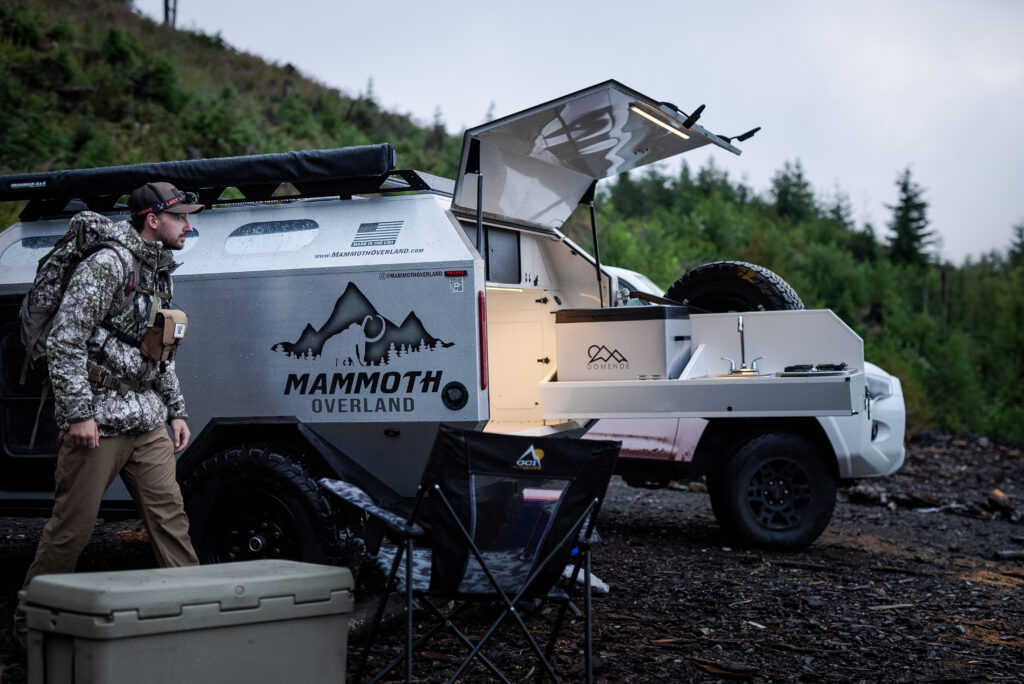
The Mammoth Overland HV is the brand’s standard off-road teardrop trailer, starting at $32,500. Built from aerospace-grade aluminum with a monocoque body, the HV weighs just 1,650 pounds dry, making it towable by mid-size trucks and SUVs while delivering the off-road durability and engineering pedigree shared across the entire Mammoth Overland lineup.
The Short Answer
The HV is Mammoth Overland’s entry point, and it’s the platform the rest of the lineup is built on. The WLY and ELE both use the HV as their base, adding cold-weather and survivalist systems respectively. If you want to understand Mammoth Overland’s core engineering before evaluating the more specialized models, the HV is where to start.
Full Specifications
|
Spec |
Detail |
|---|---|
|
Starting price |
$32,500 |
|
Dry weight |
1,650 lbs |
|
Max gross weight |
3,500 lbs |
|
Tongue weight |
280 lbs |
|
Length |
13′ 11″ |
|
Width |
7′ 3″ |
|
Exterior height |
6′ 2″ |
|
Interior cabin height |
4′ 2″ |
|
Rear hatch clearance |
6′ 8″ at lowest point |
|
Suspension |
Timbren 3500HD independent |
|
Tires |
30″ BFGoodrich KO2 on 16″ steel wheels |
|
Brakes |
Electric |
|
Battery |
100Ah AGM |
|
Inverter |
1kW true sine wave inverter/charger |
|
Water tank |
21 gallons |
|
Mattress |
77″ long, 76″ wide for first 46″, 57″ between wheel wells |
What Comes Standard
The HV ships with a genuinely usable baseline rather than a stripped shell:
- Timbren 3500HD independent suspension
- 30″ BFGoodrich KO2 tires on 16″ steel wheels
- Electric brakes
- Galley kitchen with two-burner stove, sink, and electric cooler/fridge
- 21-gallon water tank with on-demand hot water
- Outdoor shower with pop-up privacy shelter
- Portable cassette toilet
- 100Ah AGM battery with 1kW true sine wave inverter/charger
- Solar hook-up (15-amp controller with SAE connections)
- Rugged rock sliders and LED rock lights
- Stabilizing jacks
- Modular roof rack with three cross rails
- Large front storage box
- Awning
- Mattress
- Fold-down bunk sized for kids or dogs
- Plumbed propane
The HV rides on Timbren 3500HD independent suspension — an axle-less design, meaning there is no through-axle beam spanning the trailer underneath. Each wheel operates on its own independent trailing arm.
That architecture matters more than it sounds. A conventional trailer axle is a solid beam running wall to wall beneath the frame, and it’s typically the lowest point on the trailer — the thing that catches on rocks, ruts, and high centers. Removing it entirely raises effective ground clearance without lifting the body, and lets each wheel articulate independently over uneven terrain rather than transmitting movement across to the opposite side.
Paired with rugged rock sliders and available 33″ tires via the 2″ lift package, the HV is genuinely capable on technical terrain despite its modest weight and price.
Popular Options
The HV is built to be configured. The most commonly selected upgrades:
|
Option |
Price |
|---|---|
|
2″ suspension lift with 33″ tires on 17″ wheels (+3″ total height) |
$1,000 |
|
Cabin heater — Dickinson Marine Newport propane |
$1,900 |
|
Cabin heater — Truma VarioHeat |
$2,350 |
|
Cabin cooling — Fresair S6 (up to 40° temperature drop) |
$2,500 |
|
Cabin cooling — Dometic air conditioner |
$3,500 |
|
Battery upgrade — 200Ah AGM with 2kW inverter |
$850 |
|
Battery upgrade — 400Ah lithium with 2kW inverter |
$3,500 |
|
Solar — 100W portable panel |
$325 |
|
Solar — two 100W panels with Bluetooth module |
$575 |
|
Solar — 30-amp controller with two 200W panels |
$1,000 |
|
3-axis off-road hitch |
$550 |
|
Spare tire swing-out |
$1,800 |
|
Extended bunk (8 additional inches) |
$700 |
|
Interior shelving (as standard on ELE and WLY) |
$1,500 |
|
Roof-mounted standing platform |
$950 |
|
Water tank heater |
$300 |
|
Textured paint in eight colors |
$2,500 |
|
Interior netting (six nets) |
$600 |
Note that cabin heating and cooling are both options rather than standard equipment on the HV. Buyers planning cold-weather use should either budget for the heater and water tank heater or consider the WLY, which is purpose-built for those conditions.
How the HV Compares to the Rest of the Lineup
The HV is the foundation of Mammoth’s teardrop platform. The WLY takes the HV and adds R25 floor insulation, wool-lined R12 walls, an 800Ah self-heating lithium battery bank, a Truma VarioHeat, winterproofed heated water lines, and 33″ Toyo tires — for $59,500. The ELE takes the HV and adds a sealed pressurized cabin, air purification, bear-spray defense, weapons storage, and bulletproof windows — for $69,500.
All three share the same 4’2″ interior cabin height, 21-gallon water tank, and Timbren 3500HD suspension. Buyers who need to stand up inside, or who need to sleep more than two adults, should look at the TL instead.
Frequently Asked Questions
How much does the Mammoth HV cost? The HV starts at $32,500. Cabin heating, cooling, solar panels, and the suspension lift are all optional, so most real-world builds land above the base price.
How much does the Mammoth HV weigh? 1,650 pounds dry with a max gross weight of 3,500 pounds and 280 pounds of tongue weight, making it towable by most mid-size trucks and larger SUVs.
Can you stand up inside a Mammoth HV? No. The HV’s interior cabin height is 4’2″, which is typical for a teardrop-style trailer. The TL is Mammoth’s full-height model, with 6’3″ of interior height.
Does the Mammoth HV come with a heater? No, cabin heat is an option — either the Dickinson Marine Newport propane heater at $1,900 or the Truma VarioHeat at $2,350. Buyers focused on cold-weather camping should also consider the WLY.
What suspension does the Mammoth HV use? Timbren 3500HD independent axle-less suspension, which eliminates the through-axle beam that typically hangs below a trailer frame and limits ground clearance.
Ready to build your own HV? Configure your trailer or place your reservation directly with Mammoth Overland.